Organize Leads, Manage Deals and Build a More Focused Sales Process with Pipedrive
Pipedrive is a sales-focused customer relationship management platform built to help businesses organize leads, manage deals, track sales activities, automate repetitive tasks, and understand pipeline performance. Its visual pipeline gives sales teams a clear view of active opportunities, while contact management, reporting, integrations, and AI-powered tools help teams maintain consistent sales workflows from the first interaction through deal completion.
CRM · Sales Pipeline · Automation · Insights · AI

What is Pipedrive?
Pipedrive is a cloud-based customer relationship management platform designed primarily around sales activities, leads, contacts, deals, and pipeline management. Instead of treating a CRM simply as a database of customer information, Pipedrive organizes sales work around the actions that move opportunities forward.
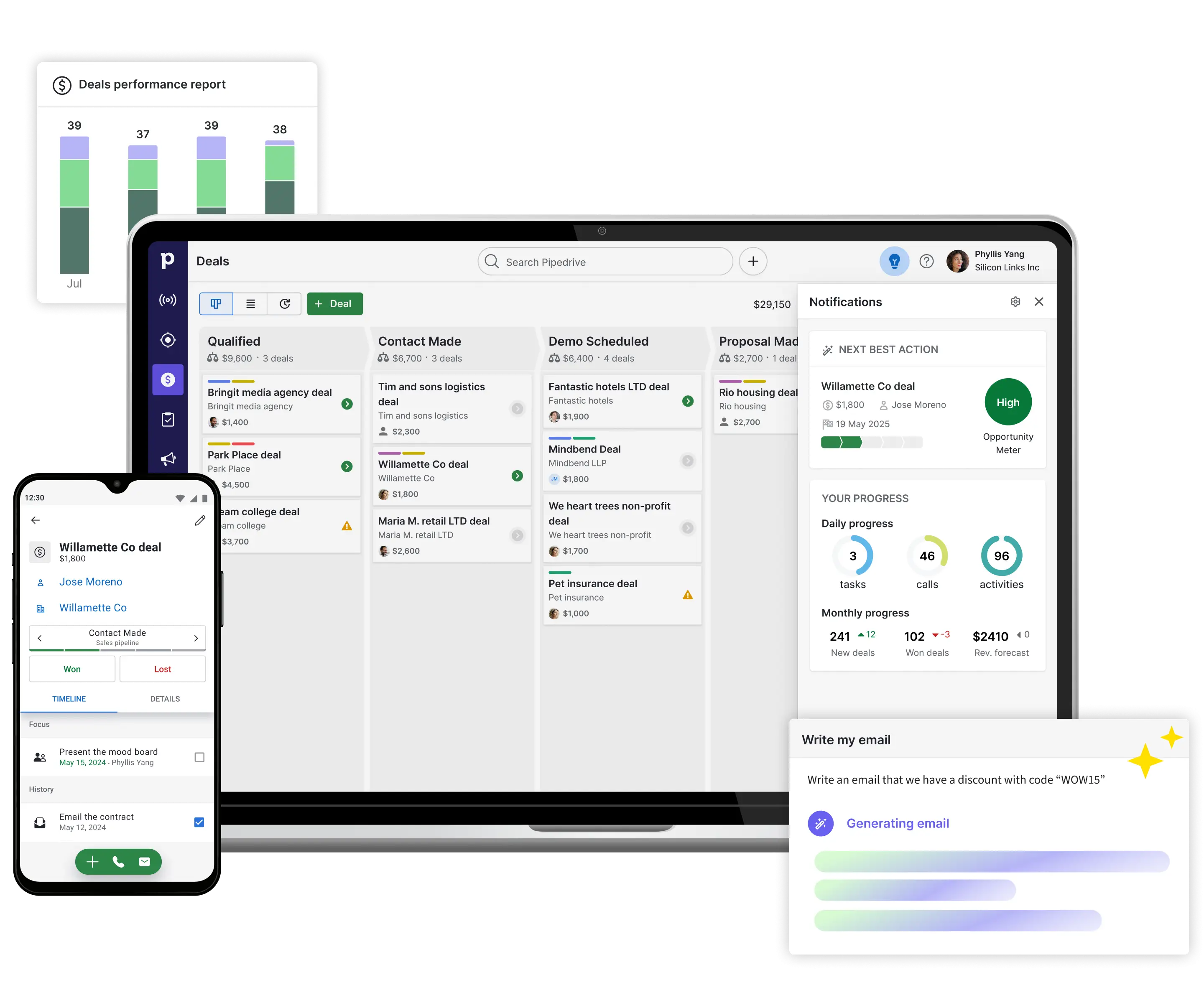
At the center of Pipedrive is a visual sales pipeline. Teams can create stages that reflect their sales process, add deals to the appropriate stage, and move opportunities forward as conversations, meetings, proposals, and negotiations progress.
The platform also brings together contact information, activities, communication history, reminders, reporting, automation, and integrations. This allows sales teams to keep important relationship and deal information connected rather than managing every part of the sales process in separate spreadsheets or applications.
Pipedrive is specifically oriented toward sales workflows, so its usefulness depends on how closely its pipeline, activity management, automation, integrations, and available add-ons match the way a particular organization sells.
How does Pipedrive work?
Pipedrive is built around a straightforward sales workflow, although the exact setup can differ depending on the company's sales process, team structure, and selected features.
Define the sales process
Map the stages a typical opportunity passes through, from initial qualification to negotiation and a final outcome.
Set up the pipeline
Create pipeline stages that reflect the actual steps your sales team uses when working with prospects and customers.
Add leads and contacts
Bring prospect and customer information into the CRM through imports, forms, integrations, manual entry, or supported lead-generation tools.
Create and qualify deals
Turn promising opportunities into deals and organize them according to value, stage, owner, expected close date, and other relevant information.
Schedule sales activities
Plan calls, meetings, emails, follow-ups, and other activities so opportunities continue moving through the pipeline.
Automate routine work
Use workflow automation to reduce repetitive actions such as assigning leads, creating activities, or sending follow-up communications.
Review performance
Use reports, dashboards, forecasting tools, and available AI insights to understand pipeline activity and identify areas that need attention.
What is Pipedrive CRM?
Pipedrive CRM is a sales management system that helps teams organize customer information, follow sales opportunities, and maintain a structured process for moving deals toward completion.
At the heart of Pipedrive CRM are leads, people, organizations, deals, activities, and pipelines. A lead can represent an opportunity that still needs qualification, while a deal represents a sales opportunity that can be tracked through defined pipeline stages.
Each deal can contain relevant information such as customer details, value, activities, communication history, expected dates, products, notes, and custom fields. This gives sales representatives a working view of what needs to happen next instead of relying only on static customer records.
Pipedrive also supports customizable pipelines, workflow automation, email and calendar connections, reporting, mobile access, integrations, and AI-assisted capabilities. Exact features and limits can depend on the plan, add-ons, configuration, and current product availability.

How Pipedrive CRM works in practice
A typical Pipedrive workflow connects lead management, deal progression, activities, communication, automation, and reporting in one sales process.
Capture an opportunity
Add a new prospect through manual entry, imports, forms, integrations, or supported lead-generation tools.
Organize contact information
Connect people and organizations with the relevant sales records so customer information stays available during the sales cycle.
Qualify the lead
Review the prospect's needs, fit, engagement, and potential before deciding whether it should enter the active deal pipeline.
Create a deal
Turn a qualified opportunity into a deal with information such as value, owner, stage, expected close date, and relevant activities.
Move through pipeline stages
Update the deal as conversations, demonstrations, proposals, negotiations, and other sales milestones are completed.
Track activities
Schedule calls, meetings, emails, tasks, and reminders to keep the next action visible for every opportunity.
Automate repeatable actions
Use automation rules to handle routine administrative steps and keep sales workflows consistent.
Measure pipeline performance
Review reports, goals, dashboards, forecasts, and available AI insights to understand sales activity and results.
Explore the Pipedrive sales ecosystem
Pipedrive combines core CRM functionality with sales, lead generation, marketing, document, project, AI, and integration capabilities. Availability can vary by plan and product configuration.
Sales CRM
Manage leads, contacts, organizations, deals, activities, pipelines, and sales information from one CRM environment.
LeadBooster
A lead generation toolkit that can help businesses capture and qualify prospects through supported website and prospecting features.
Campaigns
Support customer communication and email marketing workflows while connecting campaign activity with CRM data.
Insights & Reporting
Build reports and dashboards to monitor sales activity, pipeline movement, performance, and revenue-related information.
Projects
Organize post-sale work and project-related tasks connected to customer and deal information where supported.
Web Visitors
Understand website visitor activity and use available visitor information to identify potential sales opportunities.
Smart Docs
Create and share sales documents, proposals, and contracts while tracking document engagement where supported.
Marketplace
Extend Pipedrive by connecting CRM data with hundreds of supported applications and business tools.
Pipedrive AI
Use AI-assisted tools for sales insights, email creation, reporting, recommendations, and selected workflow tasks.
Pipedrive CRM features
Pipedrive combines practical sales management tools with automation, communication, reporting, customization, integrations, and AI-assisted capabilities. Feature availability depends on the current plan and selected add-ons.
Lead management
Capture, organize, qualify, and prioritize prospects before or as they enter the active sales pipeline.
Contact management
Keep people, organizations, communication history, activities, and relationship information connected to sales records.
Organization management
Connect contacts and deals with the companies or organizations involved in the sales relationship.
Deal management
Create and manage opportunities with values, stages, owners, expected dates, products, activities, and related information.
Visual sales pipelines
Use customizable stages and a visual interface to see how opportunities are progressing through the sales cycle.
Workflow automation
Build automated actions that respond to defined triggers and reduce repetitive sales administration.
Reports & dashboards
Monitor sales activities, pipeline movement, goals, performance metrics, and other business information.
Sales forecasting
Use pipeline information, historical performance, and forecasting tools to estimate future sales activity and revenue.
Email & communication
Connect supported email accounts, track communication, use templates, and keep conversations associated with CRM records.
Custom fields
Capture information that is specific to a company's products, customers, sales process, or reporting requirements.
CRM integrations
Connect Pipedrive with supported marketing, communication, productivity, accounting, project, and sales applications.
Mobile CRM access
Access customer information, update records, manage activities, and prepare for sales interactions from mobile devices.
AI-assisted sales tools
Use available AI features for sales recommendations, email assistance, reporting, summaries, and data-driven insights.
Data management
Import, export, organize, merge, and maintain CRM information so sales records remain usable and consistent.
Pipedrive's broader sales capabilities
Pipedrive extends beyond a basic contact database with tools designed to support prospecting, communication, sales operations, reporting, documents, automation, and connected workflows.
Pipedrive's sales environment can help teams manage opportunities from initial prospecting through deal completion. Lead tools can support prospect capture and qualification, while pipelines provide a visual representation of active opportunities. Email and communication features keep sales conversations connected to records, automation handles repeatable activities, reporting helps managers review performance, and AI-powered capabilities can provide recommendations or assist with communication and analysis. The Marketplace adds further options for connecting external business software.
How Pipedrive AI supports sales workflows
Pipedrive AI adds machine-assisted features to selected parts of the CRM, helping sales teams work with customer information, communication, reporting, and pipeline data more efficiently.
- Highlighting relevant sales information and potential opportunities
- Helping create sales reports using natural-language prompts
- Identifying patterns and useful signals within sales data
- Providing recommendations around deals and next actions
- Assisting with sales email creation and communication
- Supporting deal prioritization and sales performance analysis
- Reducing manual work across selected sales and CRM tasks
AI functionality can change as Pipedrive develops its products. Availability may depend on the current plan, feature status, configuration, or beta access. AI-generated recommendations and content should be reviewed by users before important business decisions are made.
Automation in Pipedrive
Pipedrive automation can help teams reduce repetitive administrative work by connecting triggers with predefined actions throughout the sales process.
Lead assignment
Automatically route new leads to appropriate team members when defined conditions are met.
Sales notifications
Notify team members when important changes, activities, or pipeline events require attention.
Follow-up activities
Create tasks or reminders automatically so important next steps are less likely to be overlooked.
Workflow rules
Connect a trigger to one or more actions and standardize repeatable steps in the sales process.
Record updates
Automate selected changes to CRM records when predefined sales conditions occur.
Activity creation
Generate follow-up tasks and activities automatically after specific sales events.
Email workflows
Support timely communication with automated actions and templates where the selected configuration allows it.
Administrative workflows
Reduce repetitive CRM administration by automating predictable tasks that follow defined sales events.
Automation works best when it reflects a clearly defined sales process. Teams should test workflows carefully so automated actions support the customer journey rather than creating unnecessary messages or tasks.
Pipedrive integrations & connected workflows
Pipedrive can connect with external applications through its Marketplace, supported integrations, APIs, and other connection methods, helping businesses keep sales information connected across their technology stack.
CRM integrations
Connect Pipedrive with applications used for sales, customer management, lead generation, and business operations.
Email platforms
Connect supported email services to keep sales communication and CRM records aligned.
Accounting tools
Connect CRM and finance-related applications to support workflows involving customers, deals, billing, or revenue.
Marketing platforms
Share relevant prospect and customer information with supported marketing and campaign tools.
Communication tools
Connect supported calling, video meeting, messaging, and communication services to sales workflows.
Productivity applications
Connect calendars, collaboration platforms, task tools, and other applications used by sales teams.
Open API
Develop custom connections and workflows when a required business process is not covered by an existing integration.
Marketplace apps
Extend Pipedrive with additional applications and integrations available through the Pipedrive Marketplace.
Integration availability can change by application, plan, technical setup, permissions, and provider requirements. Confirm the current integration documentation before designing a critical business workflow around a specific connection.
Potential benefits of using Pipedrive
Clear sales visibility
A visual pipeline gives teams a practical way to see active opportunities and their current stages.
Centralized customer records
Keep customer details, organizations, deals, activities, and communications connected in the CRM.
Reduced repetitive work
Automation can take care of selected routine sales activities and administrative actions.
Flexible pipelines
Teams can configure stages, fields, and pipeline structures around their sales process.
Sales reporting
Use reports and dashboards to understand activity, deal progression, performance, and pipeline trends.
Large integration ecosystem
Connect supported third-party applications to extend CRM functionality and connect existing workflows.
Scalable sales processes
Teams can add pipelines, fields, automations, integrations, and other capabilities as processes develop.
AI-assisted productivity
Available AI features can help with sales insights, email writing, reporting, recommendations, and selected CRM tasks.
These are potential benefits rather than guaranteed outcomes. Results depend on the quality of the sales process, CRM configuration, data accuracy, team adoption, and the specific Pipedrive features selected.
Who is Pipedrive for?
Pipedrive is designed around sales and relationship management, making it relevant to teams that need a structured way to manage opportunities and sales activities.
The right CRM depends on factors such as sales complexity, team size, required integrations, reporting needs, data structure, budget, automation requirements, and the amount of customization needed. Pipedrive can be particularly relevant when a business wants its CRM organized around deals, activities, pipeline stages, and sales execution.
Common Pipedrive use cases
Sales pipeline management
Organize opportunities by stage and maintain visibility across the sales cycle.
Lead management
Capture, qualify, prioritize, and convert potential customers into active sales opportunities.
Sales communication
Keep email, meetings, calls, notes, and follow-up activities connected with customer records.
Revenue tracking
Monitor deal values, pipeline totals, sales performance, and available forecasting information.
Proposal management
Create, share, and track supported sales documents and proposals through connected CRM workflows.
Sales analytics
Build reports and dashboards that help teams understand sales activity and pipeline performance.
Sales automation
Automate repeatable tasks, notifications, assignments, and selected customer follow-up processes.
Customer data organization
Keep people, organizations, deals, activities, products, and sales history connected in one system.
Pipedrive vs. other CRM platforms
The following comparison provides a high-level orientation rather than declaring one CRM universally better than another. Features, plans, pricing, integrations, and product positioning can change, so current provider information should be checked before choosing a platform.
| Platform | CRM | Sales Pipeline | Lead Management | Marketing | Automation | Analytics | AI | Customization | Typical Focus |
|---|---|---|---|---|---|---|---|---|---|
| Pipedrive | Yes | Strong | Yes | Via features/add-ons | Yes | Yes | Pipedrive AI | Flexible | Sales-focused teams wanting visual pipeline management |
| Salesforce | Yes | Yes | Yes | Broad ecosystem | Yes | Advanced | AI capabilities | Extensive | Organizations with complex CRM requirements |
| HubSpot | Yes | Yes | Yes | Strong | Yes | Yes | AI capabilities | Broad | Teams combining CRM, marketing, sales, and service workflows |
| Zoho CRM | Yes | Yes | Yes | Via ecosystem | Yes | Yes | Zia AI | Broad | Businesses seeking a wider business software ecosystem |
A useful CRM comparison should consider the complete sales process, required integrations, user experience, reporting needs, automation, customization, implementation effort, security requirements, and current pricing rather than relying on feature counts alone.
How much does Pipedrive cost?
Pipedrive pricing depends on the selected plan, billing arrangement, number of users, optional add-ons, and any applicable regional or promotional terms. Because plan names, limits, and prices can change, the current pricing page should be checked before making a purchasing decision.
Lite
A starting plan for teams that need core sales CRM capabilities such as pipeline, deal, contact, and activity management.
Check Current PricingGrowth
A higher-level plan designed for teams that need additional sales workflow, communication, automation, and productivity capabilities.
Check Current PricingPremium
A more advanced option for organizations requiring expanded customization, automation, analytics, and sales management capabilities.
Check Current PricingUltimate
A higher-tier plan that can provide additional controls, security, functionality, and resources for more demanding sales environments.
Check Current PricingThings to consider before choosing Pipedrive
Potential strengths
- Visual pipeline structure built around sales opportunities
- Strong focus on deals, activities, contacts, and sales execution
- Customizable sales stages and CRM fields
- Automation for repeatable sales and administrative tasks
- Reporting, forecasting, integrations, and AI-assisted tools
Considerations
- Some capabilities may require higher plans or additional products
- Teams with highly complex requirements should evaluate customization carefully
- Integration needs should be checked before implementation
- CRM data quality depends on consistent team usage and processes
- Total cost can depend on users, plans, and optional add-ons
Getting started with Pipedrive
Map your sales process
Write down the actual steps a prospect follows from first contact to a completed or lost opportunity.
Choose the appropriate plan
Compare current plans and select the features, limits, and controls that match your team's requirements.
Build your pipeline stages
Create stages that reflect real sales milestones rather than adding unnecessary steps that make the pipeline difficult to maintain.
Configure users and permissions
Set up team members, roles, visibility, ownership, and access rules according to your organization's workflow.
Import customer data
Move relevant contacts, organizations, deals, products, and other useful information into the CRM.
Customize important fields
Add the information your sales team genuinely needs for qualification, follow-up, reporting, and customer management.
Connect essential tools
Integrate email, calendars, communication tools, marketing systems, accounting software, or other applications where required.
Create useful automations
Automate predictable activities such as notifications, assignments, reminders, and selected follow-up actions.
Train the sales team
Make sure users understand how to update deals, schedule activities, record communication, and maintain accurate CRM data.
Review and improve the pipeline
Use reports and team feedback to identify bottlenecks, remove unnecessary steps, and refine the sales workflow over time.
Frequently asked questions
What is Pipedrive?
Pipedrive is a cloud-based sales CRM designed to help businesses organize leads, contacts, deals, activities, sales pipelines, communication, automation, and performance data in one environment.
What is Pipedrive CRM?
Pipedrive CRM is the platform's core customer relationship management system. It helps sales teams manage contacts, organizations, leads, deals, activities, pipeline stages, communication, and sales information throughout the customer journey.
How does Pipedrive work?
Pipedrive works by organizing sales opportunities inside customizable pipelines. Teams add leads and contacts, create deals, move those deals through defined stages, schedule activities, communicate with prospects, automate repetitive tasks, and use reports to evaluate sales performance.
Is Pipedrive a CRM?
Yes. Pipedrive is a customer relationship management platform with a strong focus on sales pipeline and deal management. Its CRM functionality includes contact management, lead management, activities, communication, reporting, automation, integrations, and related sales tools.
What is Pipedrive mainly used for?
Pipedrive is mainly used to organize sales processes, manage leads and deals, track customer interactions, schedule sales activities, automate repetitive work, and monitor pipeline and sales performance.
Does Pipedrive use AI?
Yes. Pipedrive provides AI-assisted features that can support sales insights, email creation, reporting, recommendations, deal prioritization, and other CRM tasks. The exact availability of AI features can depend on the current plan and product configuration.
Is Pipedrive suitable for small businesses?
Pipedrive can be used by small businesses that need a structured sales CRM for leads, deals, activities, and customer information. Suitability depends on the team's sales process, budget, required integrations, number of users, and desired features.
What features does Pipedrive offer?
Pipedrive offers features for lead and deal management, visual sales pipelines, contact management, activity tracking, automation, email and communication, reporting, forecasting, customization, integrations, mobile access, prospecting, documents, and AI-assisted sales workflows.
Can Pipedrive integrate with other software?
Yes. Pipedrive supports connections with external applications through its Marketplace, integrations, APIs, and other supported methods. Available connections vary by application and current product support.
How much does Pipedrive cost?
Pipedrive pricing depends on the selected plan, users, billing arrangement, optional add-ons, and other applicable terms. Current plans and prices should be checked directly with Pipedrive because pricing and feature limits can change.
Does Pipedrive have a visual sales pipeline?
Yes. Visual pipeline management is one of Pipedrive's central CRM features. Teams can create stages that match their sales process and move deals through those stages as opportunities progress.
Can Pipedrive automate sales tasks?
Yes. Pipedrive provides workflow automation that can handle selected repetitive actions based on defined triggers and conditions. Examples can include creating activities, updating records, sending notifications, and supporting follow-up workflows.
Does Pipedrive have a mobile app?
Yes. Pipedrive provides mobile applications that allow users to access CRM information, manage activities, update records, prepare for sales interactions, and work with customer information while away from a desktop.
What is the difference between Pipedrive and Salesforce?
Pipedrive and Salesforce are both CRM platforms, but they can differ in product breadth, customization, implementation requirements, pricing structures, ecosystem options, and target use cases. The most suitable option depends on the complexity of the organization's sales and CRM requirements.
What should I consider before choosing Pipedrive?
Consider your sales process, team size, required pipeline structure, automation needs, integrations, reporting requirements, customization, data management, security controls, mobile requirements, and the current cost of the plans and add-ons you need.
Explore Pipedrive and build a clearer sales workflow
Use Pipedrive to organize sales information, visualize opportunities, manage activities, automate repeatable work, and evaluate pipeline performance. Before choosing a plan, compare the current features, limits, integrations, and pricing against the requirements of your sales team.
Explore Pipedrive